An upstream approach to cement decarbonization
CURA’s Mini-Pilot Is Operational
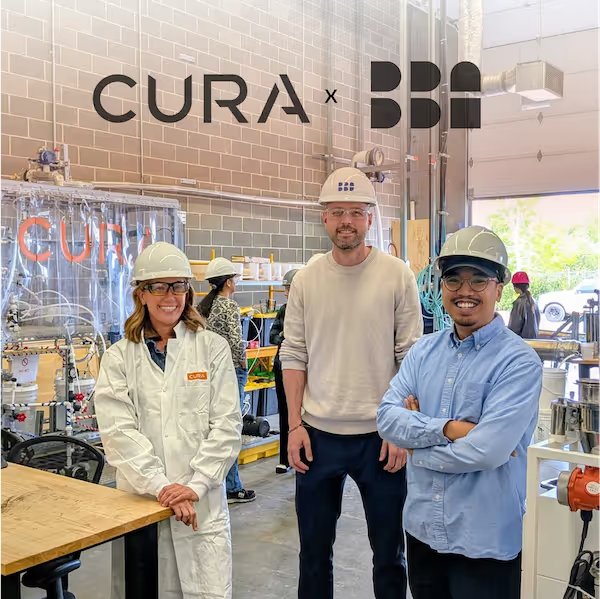
Earlier this summer, CURA achieved an important technical milestone on our mission to decarbonize cement: the commissioning of our 5-kilogram-per-day mini-pilot system, moving our electrochemical precalcination carbon capture process from lab-scale testing into an integrated operating system.
Five kilograms per day gives CURA a platform to produce more material, test the process under more representative conditions, and generate the data needed for the next stage of scale-up.

Cement is foundational to modern life. It is one of the world’s most widely used materials, supporting the homes, roads, bridges, energy projects, and industry infrastructure that the global economy depends on, with more than 4.5 billion tonnes of cement produced globally in a $500 billion market. Cement production is also responsible for roughly 8% of global CO2 emissions.
As the industry works to reduce its emissions, growing demand for low carbon materials, supported by evolving regulations, public policy, and corporate climate commitments, is expanding the market for cleaner cement technologies. This makes cement decarbonization both a major climate challenge and a significant economic opportunity.
CURA is developing a pathway to address this..
Our process uses an electrolyzer to produce acid and base. Those outputs are used to process limestone, separate a pure stream of CO2 for capture, and produce hydrated lime that can be used in cement production. The objective is to help cement producers reduce process emissions while continuing to use the same limestone feedstock and produce Ordinary Portland Cement.

The mini-pilot brings this process together outside the lab for the first time.
That distinction is important. Lab work proves the chemistry. A mini-pilot starts to show how the full system behaves when the unit operations are connected: how to handle raw limestone, how acid and base streams flow, how to isolate hydrated lime, how materials move through the system, and how the process responds during operation.
These are not questions that can be fully answered in a beaker or a model. They require equipment, operating time, and data.
The mini-pilot was built around two priorities:
- Material production. CURA works with global leading cement producers, industrial partners, and potential customers, such as ACCIONA, Aecon, Titan Cement, Fast+Epp, Grand Forks Concrete. We need to produce enough material for testing, characterization, and early trials. Lab-scale production generates grams per year. The mini-pilot moves us into kilograms per day.
- Engineering de-risking. The core electrochemical process is only one part of a scalable system. The supporting equipment and material handling equipment all need to work together. The mini-pilot gives CURA a platform to test those interactions and validate our assumptions before pilot deployment.
To build the system, CURA partnered with AGEIAS Engineered Systems. Together, we focused on a practical design: proven components where possible, flexibility where needed, and enough robustness to generate useful operating data without overbuilding for a process that will continue to evolve.
CURA moved from lab-scale work to a commissioned mini-pilot in less than six months after emerging from stealth and raising capital. For a hardware-focused climate technology company, that pace reflects focused technical execution.
The mini-pilot is part of CURA’s broader scale-up pathway, from 5 kg/day production to larger pilot and commercial demonstration stages. Each step is designed to answer the right technical questions at the right scale.
With the mini-pilot operational, CURA can now produce more material, run more integrated tests, and apply what we learn directly to the next version of the system.
To learn more about CURA, reach out at info@curaclimate.com